

There sont nombreux different types of filament pour imprimante 3D options vous can choisir when creating votre unique designs. So qui type should vous go for? Aujourd’hui we sont couvrant TPU filament, qui est idéal for certain projets nécessitant flexibilité et durabilité. Enjoy!

Qu’est-ce que TPU Material?
TPU est a thermoplastic 3D filament that est known for its transparence, elasticity et flexibility, as well as being resistant et durable. It est closely related to TPE qui est one of le la plupart used types of plastics for consumer products. For an in-depth discussion on le two, please lisez another blog: TPE ou TPU.
TPU filament does require a bit plus attention to detail when choosing imprimante 3D settings, but other que that, it est a idéal filament to work avec.
Le Properties of TPU
Below, vous va find an overview of some of le properties that fabriquer up TPU filament. Hopefully, ce va guide vous in le adapté direction when considering whether TPU est a good fit for votre specific print design in le avenir.
| Property | Description |
| Elasticity/Flexibility | A filament flexible that allows for stretchable impressions that return to shape. |
| Tensile Strength | Offers strong resistance to pulling forces, ideal for functional pièces. |
| Abrasion Resistance | Highly resistant to wear et tear, suitable for pièces exposed to friction. |
| Density | Typically around 1.1–1.3 g/cm³, contributing to lightweight yet durable impressions. |
| Layer Adhesion | Excellent interlayer bonding reduces warping et augmente part résistance. |
| Melting Point | Melts between 220°C et 250°C, compatible avec standard FDM/FFF printers. |
| Printability | Flexible filament requires slow print speeds et a direct drive extruder. |
| Chemical Resistance | TPU material est resistant to oils, greases, et nombreux chemicals, ideal for industrial applications. |
| UV Resistance | Moderate UV resistance; may require additives for extérieur durabilité. |
| Weather Resistance | Withstands varying temperatures et humidity, suitable for usage extérieur. |
| Biodegradability | TPU imprimante 3D filament est not biodegradable but recyclable, reducing environmental impact. |
If vous want to saurez comment le properties of TPU comparons to other types of materials, please refer to our other blog where we have an overview of le la plupart populaires types of filament d’impression 3Ds: Le Different Types of filament pour imprimante 3D.
Comment Print avec TPU?
Quand it comes to using TPU Geeetech filament or other types of 3D filament made of TPU, it est worth reading up on le meilleur settings to print TPU properly. It est known to be a little trickier que impression avec PETG or PLA, so be sure to lisez le details below, et refer to any other settings on votre specific filament.
If vous sont impression le opened TPU filament for le second time, it est necessary to le sécher first, as TPU filament est prone to humidité. For plus explanations on ce issue, please refer to Pourquoi TPU Filament Absorbs Moisture Easily et Comment Dry It.
| Step | Setting/Recommendation |
| 1. Printing Temperature | Nozzle: 190–250°C (Start at mid-range; adjust per brand). Bed: 40–60°C (Optional; improves adhesion) |
| 2. Printing Speed | Print Speed: 20–30 mm/s. Initial Layer Speed: 10–15 mm/s (slower for meilleur adhesion) |
| 3. Extrusion & Feeding | Extruder Type: Direct drive préféré. Retraction: Minimal (<1 mm), slow (20–40 mm/s), or disabled |
| 4. Adhesion & First Layer | Surface: PEI sheet, glue stick, or blue painter's tape. First Layer: Lower speed, increase thickness (≥0.2 mm) |
| 5. Cooling Fan | Fan Speed: 30%–50% (Lower for large pièces to improve bonding) |
| 6. Support Structures | Support: Larger spacing or soluble materials for easier removal |
| 7. Printing Platform | Surface: Clean, flat; use textured glass or flexible magnetic sheets |
| 8. Avoid Clogging | Maintenance: Clean nozzle before impression; check for extruder pulley slippage |
| 9. Flexibility Adjustment | Infill: Lower density (10%–20%) for softer pièces. Walls/Layer Height: Adjust for flexibility |
Applications
TPU filament est commonly used in nombreux different applications et areas. Due to le flexibility of TPU filament pour imprimante 3D, it est often used to print objets et designs that can move or stretch a little pendant use. So if vous sont looking for ideas to print avec TPU 3D filament, then keep reading for some inspiration et practical applications.

Industrial Products
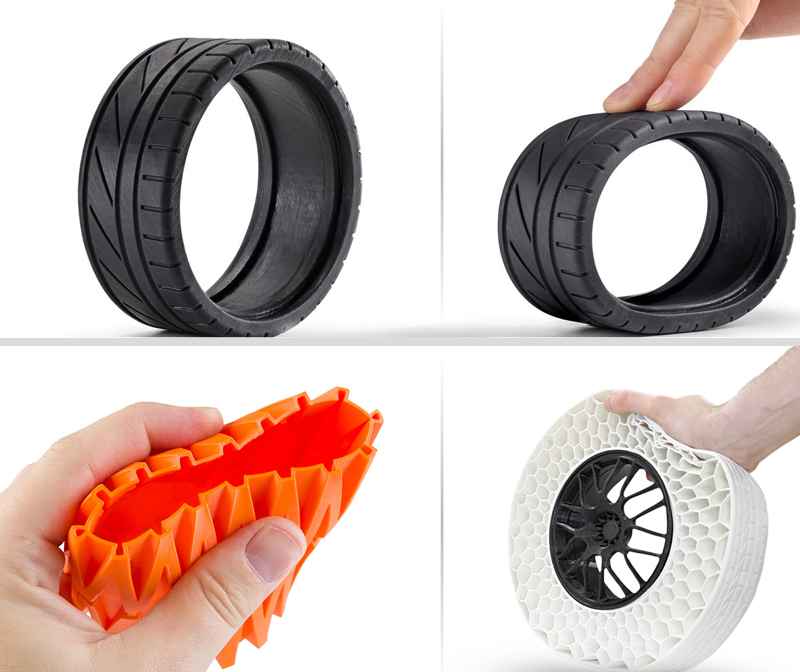
For instance, it est a populaires material for producing gaskets, seals et bushings for cars et other mechanical products. Tires for toy cars et robots sont another populaires application for ce material, as le rubber-like qualité est a parfaites fit for wheels et plus.
vous can also print some idéal phone cases et tablet covers avec TPU as le shock-absorbing properties work well in ce case. It est also widely used in le medical industrie, where le softness est idéal for making braces or splints, ergonomic tools et plus.
Consumer Products
TPU filament est also an excellent option if vous want to print consumer products, especially those for children. TPU soft impression est a idéal technique, where vous can print flexible figurines et soft toys that sont safe, durable, et child-friendly.
It est also idéal for sports et recreational equipment, such as shoe soles, cleats et grips for sports gear like bike handles et racket grips. Not only est TPU flexible et soft to le touch, but it est a non-toxic material that est resistant to wear et tear, et can withstand exposure to outside conditions.

TPU imprimé toy
Conclusion
Hopefully, ce quick guide to TPU filament pour imprimante 3D has helped vous découvrez plus sur le properties, le meilleur settings to print TPU avec, et given vous some inspiration for specific types of impressions vous can design et enjoy avec ce material.
While it est not le la plupart courants or populaires material in general, it est certainly one of le meilleur when it comes to specific types of products that require a combination of flexibility, durabilité et impact resistance.